The United States has crossed another historic financial threshold, with the national debt surpassing $40 trillion for the first time. The milestone underscores the accelerating growth of federal borrowing and intensifies concerns about the long-term consequences of persistent budget deficits, rising interest costs, defense spending and expensive programs such as Social Security and Medicare.
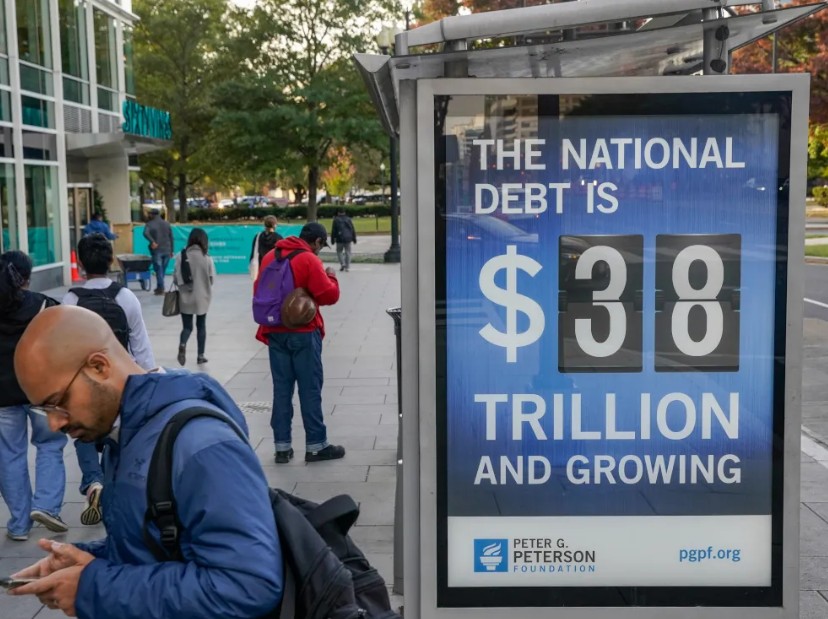
The speed at which the debt is increasing is particularly striking. The national debt reached $39 trillion only five months earlier, in March 2026, after crossing $38 trillion in October 2025. In roughly ten months, therefore, the federal government accumulated another $2 trillion in debt.
Federal debt has grown under administrations of both parties as Washington repeatedly spends more than it collects in revenue. The COVID-19 pandemic contributed significantly to recent borrowing, with the federal government approving massive spending programs during President Donald Trump’s first term and under President Joe Biden to stabilize the economy and support its recovery. More recently, additional spending followed the tax-and-spending legislation signed by Trump in 2025.
The current fiscal situation also reflects competing priorities. Washington continues financing major entitlement programs while confronting substantial defense expenditures, including costs associated with the ongoing U.S. war with Iran. At the same time, the Trump administration is attempting to reduce the cost of everyday necessities and encourage stronger economic growth.
The White House argues that it is addressing the problem by reducing waste, fraud and unnecessary federal spending while pursuing policies intended to accelerate economic expansion. Administration spokesman Kush Desai said the objective is ultimately to move America’s debt-to-GDP ratio in a more sustainable direction.
However, fiscal-policy experts warn that the consequences of rising debt are not limited to government accounting. Heavy federal borrowing can contribute to higher interest rates and increase financing costs throughout the economy. That can translate into more expensive mortgages and automobile loans for consumers while reducing the capital businesses have available for investment. Over time, slower investment can weaken productivity and wage growth.
Interest payments themselves are becoming an increasingly significant problem. As the government’s outstanding debt grows, Washington must dedicate more federal revenue simply to servicing previous borrowing. That creates difficult tradeoffs because money spent on interest cannot simultaneously finance infrastructure, education, defense, healthcare or other government priorities.
The next major confrontation could arrive relatively soon. The United States operates under a statutory debt ceiling established by Congress. The current limit stands at $41.1 trillion, and the Bipartisan Policy Center estimates the government will most likely reach that ceiling sometime between late winter and mid-summer 2027. Congress would then need to raise or suspend the limit again to prevent the Treasury from eventually becoming unable to meet all of its financial obligations.
Experts emphasize that the debt ceiling itself does not create new government spending; it determines whether the Treasury can continue borrowing to meet obligations already authorized by Congress. Nevertheless, repeated debt-limit confrontations can create uncertainty in financial markets and reopen politically difficult debates about taxes and federal spending.
The longer-term challenge is even more significant. Recent analysis from the Organization for Economic Cooperation and Development indicates that the United States has the weakest fiscal position among developed economiescuañ.
Crossing $40 trillion does not mean the United States is facing an immediate fiscal collapse. But it provides a powerful measure of how rapidly federal obligations are accumulating. Without significant changes in spending, revenues, economic growth or some combination of all three, Washington will continue confronting increasingly difficult choices over how to finance the government while preventing debt and interest payments from consuming an ever-larger share of America’s economic resources.