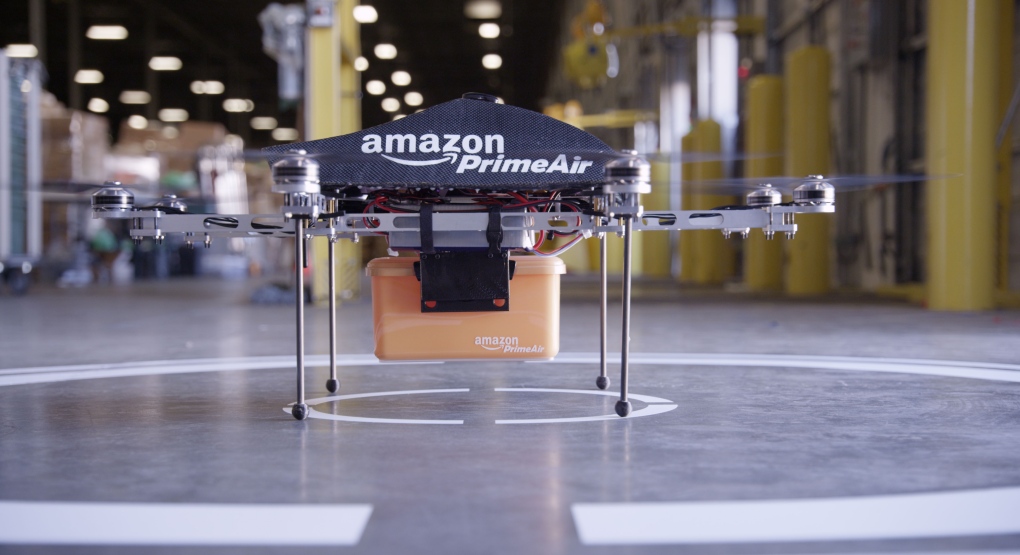
Amazon is preparing its most ambitious expansion of drone delivery yet, with plans to bring its Prime Air service to nearly 500 U.S. cities and towns by the end of 2026. The move represents a major attempt to transform drone delivery from a limited experiment into a meaningful part of Amazon’s enormous logistics network.
Prime Air allows customers to receive eligible products by autonomous drone, with Amazon advertising delivery times of as little as 30 minutes. The company plans to introduce or expand the service across metropolitan areas including Chicago, Atlanta, Cleveland, Syracuse, New York, and Boise, Idaho. Amazon currently operates Prime Air across 11 metropolitan areas, including Phoenix, Detroit, Houston, Dallas and San Antonio.
The expansion could make drone delivery available to tens of millions of Americans. Amazon Chief Executive Andy Jassy previously said Prime Air was being designed to serve communities representing approximately 30 million customers by the end of 2026. Longer term, the company has set an extraordinarily ambitious target: delivering roughly 500 million packages by drone by the end of the decade.
Customers will be able to order various lightweight products, including groceries, electronics, medications and household goods. Amazon’s current drones are designed primarily for smaller packages, reflecting one of the technology’s limitations: drones cannot yet replace vans or trucks for large or heavy orders. Instead, the company sees them as a complementary delivery option for customers who need relatively small products extremely quickly.
Amazon says it has already completed hundreds of thousands of drone deliveries during 2026, suggesting that the technology is beginning to move beyond its experimental phase. However, drone delivery still represents only a tiny portion of the billions of packages handled through Amazon’s broader logistics network.
The company is not alone in pursuing the technology. Competition across the American drone-delivery market is accelerating. Walmart is expanding drone deliveries through its partnership with Alphabet’s Wing, while DoorDash recently secured an important Federal Aviation Administration certification for commercial drone operations. Uber has also partnered with Zipline as companies increasingly compete to reduce delivery times for food, groceries and retail products.
Several significant obstacles remain before drones become commonplace above American neighborhoods. Companies must comply with complex aviation regulations while addressing concerns involving safety, privacy, noise and reliability during bad weather. Residents in some communities have complained about drone noise, encouraging developers to experiment with quieter aircraft and alternative delivery systems.
Economics may be an even bigger challenge. Amazon and its competitors must demonstrate that autonomous aircraft can eventually deliver packages more efficiently than conventional cars, vans or bicycles. Traditional delivery networks benefit from transporting many packages on a single route, while a drone generally carries only one lightweight order at a time. Reducing the cost of each flight will therefore be critical to making the business sustainable.
Regulatory changes could accelerate the industry’s development. Drone companies have historically faced restrictions requiring operators to maintain visual contact with aircraft, making large-scale networks difficult to operate. The industry has increasingly pushed for rules allowing more routine beyond-visual-line-of-sight operations, which would enable companies to supervise much larger fleets over greater distances.
Amazon’s expansion therefore represents more than another delivery option for Prime customers. It is a test of whether autonomous aircraft can become a permanent component of American commerce.
If Prime Air successfully reaches hundreds of communities while lowering costs and maintaining public acceptance, ordering a small product and watching it arrive from the sky within half an hour could shift from technological novelty to an ordinary part of online shopping. For Amazon, the nearly 500-community expansion is its biggest step yet toward making that future a reality.