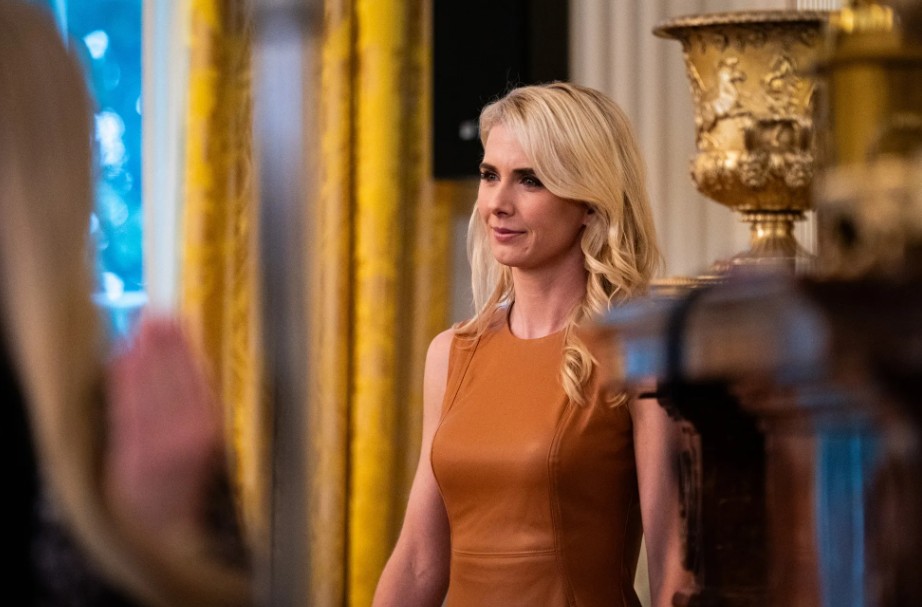
Natalie Harp, one of President Donald Trump’s closest and most trusted White House aides, has unexpectedly become the center of an increasingly personal political confrontation involving Trump, Democratic Sen. Jon Ossoff of Georgia and members of the White House communications operation. The episode illustrates both Harp’s unusual position inside Trump’s inner circle and the increasingly combative atmosphere surrounding the 2026 midterm elections.
The controversy began after Ossoff, who is campaigning for reelection in Georgia, targeted Trump during a political speech. While criticizing the president’s priorities and lifestyle, Ossoff made a pointed reference to Harp and her constant presence alongside Trump. The remark quickly attracted attention because Harp, despite rarely speaking publicly, has become one of the people with the greatest day-to-day access to the president.
The White House responded aggressively. Communications Director Steven Cheung defended Harp, while Trump personally attacked Ossoff. The reaction transformed what might have remained a campaign remark into a broader Washington controversy over Harp’s relationship with the president, her influence within the administration and whether political opponents should make presidential aides part of campaign attacks.
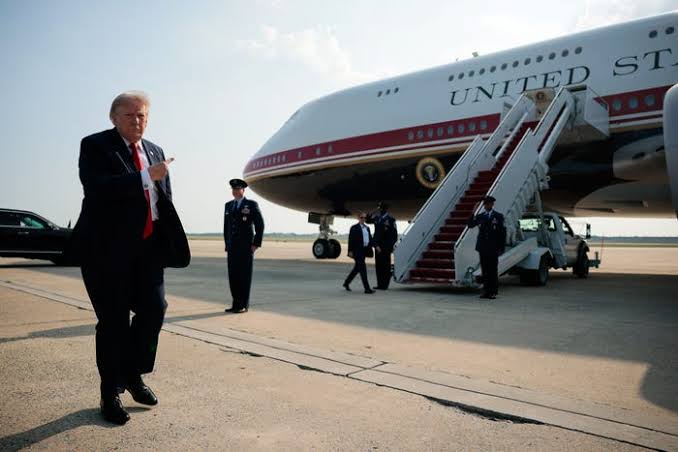
Harp, 35, occupies an unusual position in Trump’s political operation. She frequently travels with the president, helps manage his social-media communications and provides him with articles, research and other information. Her habit of carrying a portable printer and supplying Trump with printed material earned her the nickname “human printer.” She has also emerged as an important point of access for people seeking to get information directly in front of Trump.
Her relationship with Trump developed years before his return to the White House. Harp is a cancer survivor who has publicly credited Trump’s Right to Try Act, signed in 2018, with helping her obtain experimental treatment that she believes saved her life. She later spoke at the 2020 Republican National Convention, worked for One America News Network and joined Trump’s political operation in 2022.
Since then, her extraordinary loyalty has helped make her a trusted member of Trump’s inner circle. According to the media, Trump regards Harp almost like family. Her responsibilities extend beyond those normally associated with an executive assistant: she accompanies him to important events, participates in meetings, handles communications and can carry out presidential instructions directly, sometimes bypassing more senior officials.
That access has also created tensions. Some current and former Trump aides have reportedly been uneasy about the amount of influence Harp possesses despite holding a relatively low-profile position. Her ability to determine which information reaches Trump can make her an important informal gatekeeper inside an administration where personal access to the president carries considerable political power.
For Democrats, Harp’s prominence offers another way to criticize Trump’s governing style and the structure of his inner circle. Republicans, however, have portrayed attacks against her as inappropriate and, in some cases, sexist. The dispute therefore raises a broader question about where legitimate political criticism ends and personal attacks on unelected staff members begin.
The confrontation also arrives as the 2026 midterm elections intensify. Ossoff is seeking reelection in a politically competitive state, and Trump remains the dominant figure in the Republican Party. Both sides are increasingly searching for arguments capable of energizing voters, making even relatively obscure White House personnel potential subjects of national political debate.
Ultimately, the controversy reveals how influential Harp has become without developing the public profile normally associated with senior presidential advisers. Her proximity to Trump, role in managing information and communications, and intense loyalty have given her an unusual place in the White House. What began as a campaign attack has consequently exposed a larger story about access, loyalty and informal power inside Trump’s presidency—and how those relationships are becoming political ammunition ahead of the midterms.