President Donald Trump intensified his campaign efforts ahead of the November 3 midterm elections, holding rallies in Arizona and Montana to support Republican candidates as the party seeks to maintain control of Congress.
During his October 14 appearances, Trump emphasized gun rights, defended his acceptance of a luxury aircraft from Qatar and promoted his administration’s accomplishments. The visits came amid concerns about inflation, government spending and the political environment facing Republican candidates.
The two-state campaign swing illustrated Trump’s effort to mobilize supporters while highlighting the different issues shaping competitive elections across the American West.
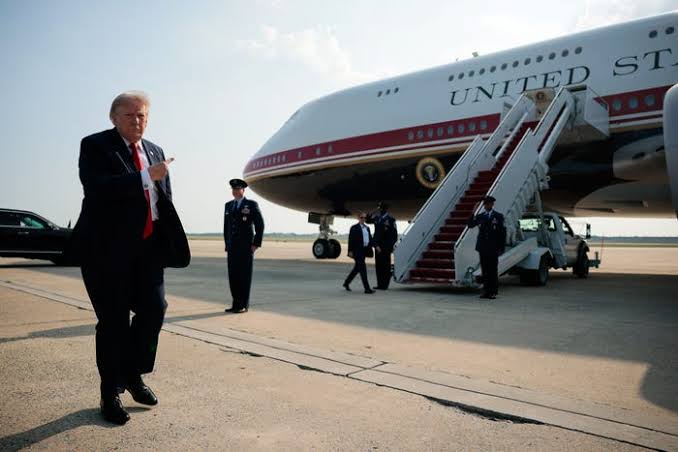
Trump began Wednesday’s campaign appearances in Bullhead City, Arizona, where he arrived aboard a Boeing 747 provided by Qatar for use as Air Force One.
The aircraft, featuring a redesigned red, white, blue and gold paint scheme, served as a prominent backdrop for the event.
Trump defended accepting the plane, describing it as a valuable gift from the Qatari royal family. The arrangement has previously drawn criticism, including from some Republicans, over questions involving government ethics and foreign influence.
The president visited Arizona to support Republican Representative Andy Biggs, who is challenging Democratic Governor Katie Hobbs.
Biggs, a longtime Trump ally and former leader of the conservative House Freedom Caucus, has emphasized immigration enforcement and conservative policies.
Trump criticized Hobbs’s approach to border security, accusing her administration of failing to confront criminal activity along the U.S.-Mexico border.
Hobbs has defended her record, pointing to the deployment of National Guard personnel and additional funding for local law enforcement.
Arizona remains politically significant because voters have supported candidates from both major parties in recent statewide elections.
Later Wednesday, Trump traveled to Kalispell, Montana, where he emphasized gun ownership and the Second Amendment.
The president warned supporters that Democrats could threaten firearm protections if they gained control of Congress.
His remarks were intended to support Republican congressional candidate Aaron Flint, who is competing against Democrat Sam Forstag in Montana’s 1st Congressional District.
Flint previously worked for retiring Republican Representative Ryan Zinke, who served as interior secretary during Trump’s first administration.
Forstag, a labor union leader and Forest Service smokejumper, has also expressed support for gun ownership while advocating voluntary firearm-storage measures for people experiencing mental health crises.
Trump nevertheless portrayed Democratic candidates as a threat to gun rights, highlighting differences in National Rifle Association ratings.
The president also promoted Republican Senate candidate Kurt Alme and announced plans for a new military weapons-testing range in Montana.
The proposed facility, which Republican lawmakers had sought for the state, became another example of Trump using campaign appearances to publicize federal initiatives.
The Western campaign tour occurred less than three weeks before Election Day, as Republican and Democratic organizations reassessed spending priorities in competitive congressional districts.
Republican groups had begun withdrawing resources from some closely contested House races, while Democratic organizations increased financial support for candidates in districts that had previously received less attention.
These strategic changes reflected shifting campaign assessments, although they did not establish how individual elections would ultimately be decided.
Trump’s recent appearances had included several Republican-leaning states, making Arizona an important addition to his campaign schedule.
His administration has also faced criticism over the cost of living, federal policy decisions and the ongoing conflict involving Iran.
While many voters remain concerned about household expenses, Trump frequently used his speeches to discuss other subjects, including the new presidential aircraft and renovation projects in Washington.
The November elections will determine control of the House of Representatives and Senate, influencing the Trump administration’s ability to advance legislation during the remainder of his term.
Republicans are emphasizing immigration enforcement, gun rights and their economic policies.
Democrats are focusing on affordability, government accountability and opposition to several administration priorities.
Both parties are investing in advertising, fundraising and voter mobilization as Election Day approaches.
Trump’s Arizona and Montana rallies demonstrate how national political debates are shaping local contests, with voters preparing to decide the future balance of power in Washington.