Billionaire entrepreneur Elon Musk has emerged as the largest publicly identified political donor in the 2026 United States midterm elections, contributing more than $276 million since July to support Republican candidates and help the party maintain its congressional majorities.
The extraordinary spending comes as Republicans face a challenging political environment ahead of the November 3 elections, with concerns about inflation, economic uncertainty and President Donald Trump’s approval ratings creating opportunities for Democratic challengers.
Musk’s financial intervention represents one of the most significant examples of billionaire influence in modern American politics, highlighting the growing importance of wealthy donors in determining campaign strategies and political advertising.
According to data, the technology entrepreneur has directed enormous sums toward Republican-aligned political groups. The largest contribution, approximately $158 million, went to the Senate Leadership Fund, a super PAC dedicated to supporting Republican candidates for the U.S. Senate.
Another $76 million was contributed to America PAC, Musk’s political organization, which has developed an extensive voter mobilization operation.
The group has focused on identifying potential Republican voters, organizing door-to-door outreach and encouraging participation in competitive elections.
Musk also contributed $10 million to Lone Star Liberty PAC, which supports Republican Senate candidate Ken Paxton in Texas.
The disclosed contributions demonstrate how a single wealthy donor can provide resources capable of transforming the financial landscape of multiple congressional races.
One of Musk’s most important political investments involves the Texas Senate race.
Republican nominee Ken Paxton is facing Democrat James Talarico in a contest that has attracted increasing national attention.
Although Texas has traditionally favored Republicans in statewide elections, the race has become more competitive as Democrats seek to capitalize on concerns about the economy and Republican leadership.
Musk’s support reflects the importance of preserving Republican representation in a state that has long played a central role in the party’s national electoral strategy.
The funding could help finance television advertisements, voter outreach and other campaign activities during the final weeks before Election Day.
However, financial advantages do not necessarily guarantee electoral victories, particularly when voter dissatisfaction is widespread.
Musk’s renewed political spending marks a significant reversal from his earlier statements.
In May 2025, following his prominent involvement in the 2024 presidential election and his leadership of the Department of Government Efficiency, Musk indicated that he intended to reduce his political contributions.
His relationship with Trump subsequently deteriorated, producing a highly public disagreement between the two influential figures.
However, their relationship has since improved.
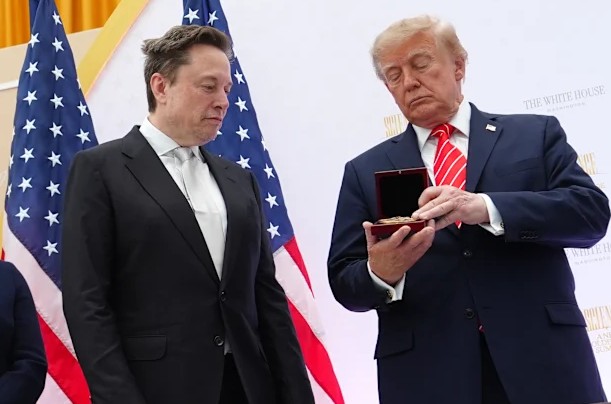
On October 8, Trump presented Musk with the National Medal of Science during a ceremony in Washington, signaling a renewed public alignment.
Unlike his highly visible participation in Trump’s 2024 campaign, Musk has maintained a comparatively low profile during the current election cycle.
Nevertheless, his financial influence has become even more significant.
Musk’s contributions have strengthened Republican fundraising at a time when the party faces difficult electoral conditions.
Republican-aligned organizations are using their financial resources to expand advertising campaigns and support candidates in competitive states.
Party strategists argue that these investments are essential for communicating Republican priorities and increasing voter turnout.
Democrats, however, have criticized the spending, arguing that enormous contributions from wealthy individuals could overshadow the concerns of ordinary voters.
Democratic representatives contend that Republican financial advantages cannot eliminate public frustration over economic conditions and government policies.
Musk’s involvement raises fundamental questions about the role of concentrated wealth in American democracy.
Political action committees can receive substantial contributions from wealthy individuals, allowing donors to exert considerable influence over campaign messaging and voter outreach.
Supporters of such spending view political contributions as a legitimate form of participation in democratic elections.
Critics argue that the growing dependence on billionaire donors risks giving wealthy individuals disproportionate influence over the political process.
With control of Congress at stake, Musk’s investments could prove strategically important for Republicans.
The ultimate test will come on November 3, when voters determine whether the Republican Party’s unprecedented financial resources can overcome dissatisfaction with the country’s political and economic direction.