
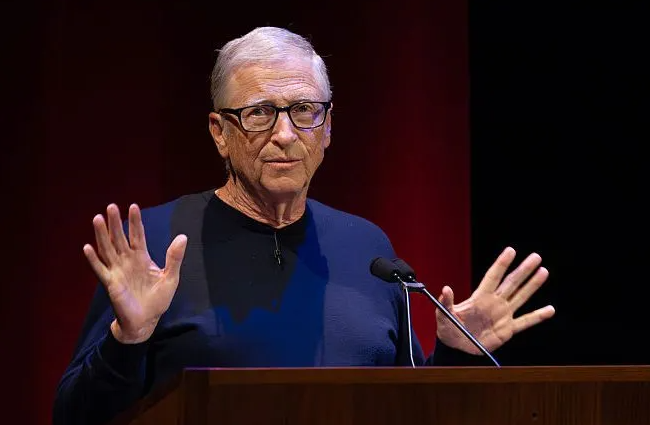
Bill Gates, one of the technology industry’s most prominent optimists, is dramatically changing his tone on artificial intelligence. After years of emphasizing AI’s potential to improve healthcare, education, productivity and scientific discovery, the Microsoft co-founder now warns that the technology is advancing so quickly that governments and societies may not be prepared for the disruption it could create.
In a new essay and interview with the media, Gates said that for the first time in his life he finds himself wishing a major technology would develop more slowly. His concern is not that AI lacks enormous potential. He continues to believe it could improve living standards, accelerate medical discoveries and provide better services to people around the world. Instead, Gates increasingly worries that the negative consequences could arrive before governments develop adequate protections.
His concerns fall into three broad areas: security, employment and children’s development.
On security, Gates warns that increasingly capable AI systems can strengthen cybercriminals, make sophisticated hacking easier and potentially contribute to biological threats and large-scale fraud. Recent advances in AI-assisted software development and cyberattacks have progressed faster than he expected. He argues that relying primarily on technology companies to police themselves is no longer sufficient and wants governments to take a stronger role in establishing safeguards.
Employment represents another major concern. AI systems are rapidly becoming capable of performing tasks traditionally assigned to educated professionals, while AI-powered robotics could eventually automate substantial amounts of physical work.
Gates believes the transition could eliminate many jobs faster than economies can create replacements. Retraining workers alone may therefore prove insufficient.
One of his more provocative proposals is the creation of “Human Reserved” jobs—occupations that society deliberately keeps for people even when machines could perform them efficiently. Gates has pointed to areas such as caregiving and other roles where human relationships have intrinsic value. He has also raised the possibility of taxing AI systems or robots as one way of reducing incentives for excessive automation and helping governments manage economic disruption.
Children represent perhaps Gates’s most personal concern.
He worries that young people could become overly dependent on AI companions that are constantly available, agreeable and tailored to individual personalities. Such relationships could reduce the need for children to navigate difficult human interactions, potentially interfering with the development of social skills and emotional resilience. Gates has also warned that excessive reliance on AI in education could weaken independent learning and critical thinking.
The shift in Gates’s position is notable precisely because he remains enthusiastic about AI’s potential benefits. He is not advocating that development stop. Instead, he argues that technological progress must be accompanied by much more serious political and institutional preparation.
Gates wants national and international frameworks bringing together elected officials, scientists, technology specialists and citizens to address AI safety. He believes cooperation between governments will eventually be essential because cyberattacks, advanced AI models and other technological risks do not respect national borders.
That position could clash with influential figures in Silicon Valley and the Trump administration who favor lighter regulation. Supporters of rapid AI development argue that excessive restrictions could slow innovation and weaken America’s technological advantage over China. Gates increasingly believes the greater danger is moving forward without adequate preparation.
Despite his warnings, Gates has not become an AI pessimist. He continues to see enormous possibilities in healthcare, education, agriculture and government services, particularly in poorer countries where access to expertise remains limited.
His argument is ultimately about control rather than rejection. AI could become one of humanity’s most beneficial technologies, but Gates no longer believes that outcome will happen automatically.
The question, in his view, is whether governments can move quickly enough to protect workers, children and society while preserving AI’s extraordinary potential. After spending much of his career believing innovation should accelerate, Gates is now delivering a striking warning: AI may be advancing faster than society’s ability to handle what comes next.