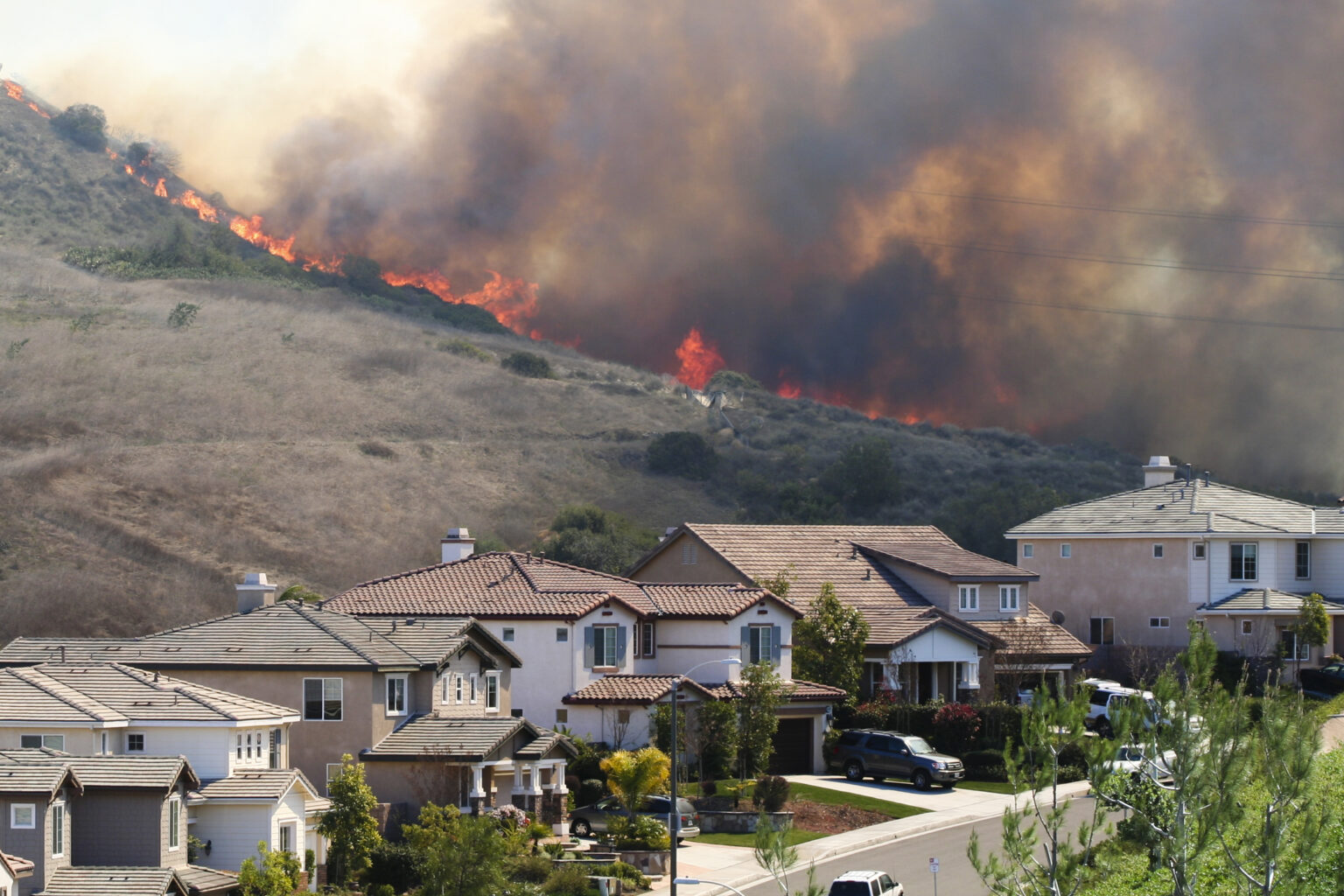
California’s property insurance crisis is expanding beyond the mountainous and heavily wooded communities traditionally considered most vulnerable to wildfires, leaving homeowners in relatively low-risk suburban neighborhoods struggling to obtain conventional coverage.
An analysis of insurance data found that major insurers are increasingly declining to write policies across large portions of the state, including rapidly growing communities in the Inland Empire.
The shift challenges the assumption that California’s insurance problems are primarily confined to areas facing extreme wildfire danger.
In 396 ZIP Codes, approximately nine out of every 10 properties added to California’s FAIR Plan between March 2025 and June 2026 were classified as having low wildfire risk. Those roughly 11,000 properties joined approximately 138,000 other low-risk homes already covered by the state’s insurer of last resort.
The situation is particularly striking along the Interstate 215 corridor, where California has been constructing large numbers of comparatively affordable suburban homes.
Some communities have experienced FAIR Plan enrollment increases of 300% to 500%. Near Menifee, enrollment grew roughly fivefold between 2024 and June 2026, while one Hemet ZIP Code generated more than 1,100 new FAIR Plan policies.
For buyers, finding insurance has consequently become a critical part of purchasing a home.
Buying a $700,000 six-bedroom house that conventional insurers would not provide comprehensive coverage. The ultimate purchase would be a policy from a surplus-lines insurer with a $25,000 deductible for fire losses.
Surplus-lines insurers have become an increasingly important alternative.
Unlike conventional insurers regulated by California, these companies can charge rates without the same price controls and offer policies that may include large deductibles or narrower protections.
They also do not participate in California’s guarantee fund. If one fails financially, policyholders do not receive the same protection available to customers of regulated insurers.
Surplus-lines carriers now represent about 7% of California’s home insurance market, compared with roughly 1% in 2021.
The other major alternative is the California FAIR Plan.
Originally intended as insurance of last resort, the FAIR Plan has expanded dramatically as traditional companies retreat. It now covers hundreds of thousands of properties and provides basic fire protection rather than the broader theft, liability and water-damage coverage included in conventional homeowners policies.
Homeowners frequently must purchase a second policy to fill those gaps.
California Insurance Commissioner Ricardo Lara has argued that reforms introduced under his Sustainable Insurance Strategy are beginning to stabilize the market.
The reforms allow insurers greater flexibility to incorporate catastrophe modeling and reinsurance expenses into their rates in exchange for commitments to write more policies in distressed areas.
In June, Lara told state lawmakers that California was finally seeing signs of stabilization, pointing partly to slower growth in FAIR Plan enrollment.
But the Times analysis presents a more complicated picture.
California has fewer traditional homeowners policies today than at any point in the past 15 years. Since the market peaked in 2016, approximately 1,300 ZIP Codes have lost 462,000 policies.
The crisis also presents a challenge for California’s housing strategy.
The state desperately needs additional homes, and inland communities have become crucial sources of relatively affordable new construction. But buyers who qualify for mortgages may discover that expensive or difficult-to-obtain insurance changes the economics of homeownership.
California’s insurance crisis is therefore becoming more than a wildfire problem.
It increasingly represents a housing affordability and financial-security problem, affecting communities that may never experience a catastrophic wildfire themselves.
For California homeowners, the question is no longer simply whether they can afford a house.
Increasingly, it is whether they can find an insurer willing to protect it.